![Servitech - Logo [Com Tagline]](https://servitech.com.br/wp-content/webp-express/webp-images/uploads/elementor/thumbs/Servitech-Logo-Com-Tagline-scaled-r94roux2gbrsca804jn1hmc3mf7m3lxhhdcrmk60po.png.webp "Servitech – Logo [Com Tagline]")
Servitech needs the information below to prepare your budget.
If not provided now, our sales team will contact you later.
Because they have magnetic cores made with High and Very High Intensity Anisotropic Permanent Magnets, they do not use electrical energy and therefore, there is no risk of burning coils or short circuits and explosions, in addition to heating, common problems in electromagnetic filters, which release impurities when there is a power outage.
Magnetic bars can be built with the following magnets: Ferrite= 1500 Gauss; Neodymium-Iron-Boron (Rare Earths), in magnetic flux densities: Normal= 3000 Gauss, Strong= 4500 Gauss, Extra-Strong= 6000 Gauss, Hyper-Strong= 7500 Gauss and Ultra-Strong=9000 Gauss. Their diameter is 25.4mm in the 1500 to 7500 Gauss models (called ‘‘Series 25’’) and 50.8mm in the 9000 Gauss model (called ‘‘Series 50’’). The temperature range for using magnetic bars is as follows: Ferrite models, up to 150ºC; Neodymium-Iron-Boron models, up to 80ºC (or 150ºC, special, upon request). They can also be built with AINiCo magnets, for temperatures of up to 350ºC.
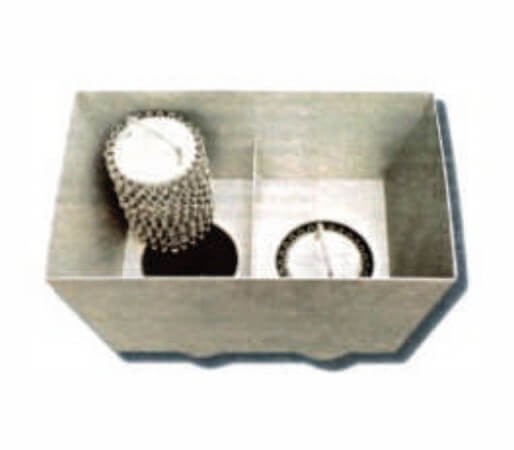
The “C-1 and C-3” models, intended for forced passages, combine the low cost of Ferrite magnets with a high degree of ferrous separation, thanks to the geometry of the magnetic element, with recesses on the surface, which hide the captured ferrous particles, preventing the liquid flow from dragging them.
When cleaning, the rings (daisies) around the magnetic element are removed and, away from the presence of magnetism, they easily release the swarf trapped in them. They can be supplied in 'buckets' which, as they already have a forced passage, are ready for installation and use.
For cases where it is not possible to create a forced passage (ideal condition for magnetic filters), there is the ‘‘C-2’’ model, which has a long-range magnetic field.
The magnetic filters are made entirely of stainless steel, allowing them to be used with practically any type of liquid, even those with high acidity or abrasion.
In the ceramic industry, the 'C' models are widely used in liquid slip or enamel lines and the magnetic bars, when built with Rare Earth magnets (NdFeB), are specifically intended for enamel lines, as, thanks to their very high intensity magnetic field, they offer a high degree of ferrous separation, removing even the finest particles.
Magnetic filters were designed to remove ferrous impurities from liquids in general, even those with higher viscosity and contaminated with extremely fine particles.
They have special application in industries where ferrous contamination is harmful to both the product and the equipment in contact with it, such as food, hydraulic and lubrication or refrigeration oil, paints, etc.


This website does not use tracking cookies or analytics tools. We only save your choice here, so as not to ask you again. See what is recorded in our Privacy Policy. Privacy Policy.
Choose what you authorize. Open each category to see exactly what is recorded in your browser, including the technical name, deadline and purpose. Full details at Privacy Policy.
Essential for the website to function and to remember your decision about cookies. They cannot be deactivated, because without them we would have to ask this every time we visit.
| Name | Type | Term | What you keep |
|---|---|---|---|
| drift_consent | Local storage | 12 months | It only saves which categories you authorized and the date of the choice. Does not contain name, email or person identifier. |
They would serve to remember interface settings you chose, such as language or display mode.
Nothing is recorded in this category today. This site does not currently use any tools of this type, the option is there so you already have control if this changes.
They would serve to measure in aggregate which pages are most visited, helping to improve the website. Without identifying you individually.
Nothing is recorded in this category today. This site does not currently use any tools of this type, the option is there so you already have control if this changes.
They would serve to measure the effectiveness of campaigns and avoid showing the same ad repeatedly.
Nothing is recorded in this category today. This site does not currently use any tools of this type, the option is there so you already have control if this changes.
São coisa diferente de cookie. Nome, e-mail, telefone e a mensagem que você escreve em "Fale conosco" só são enviados quando você preenche e confirma o aceite, e servem exclusivamente para responder você. Você pode pedir acesso ou exclusão deles a qualquer momento. See what we collected.
Fill out the form below to apply for one of our available vows.